
The whole earth was of one language and of one speech. When a man opened his mouth, the words that came out were understood by everyone who heard them. There was no translation, no confusion, no barrier between what one heart wanted to say and what another ear could receive. The world had been washed clean by the flood, and the sons of Noah had multiplied, and their children had spread out across the land, and for a time they all spoke the same tongue.
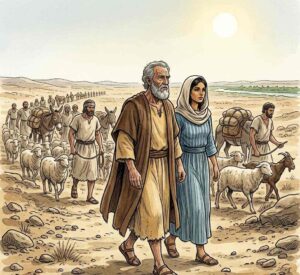
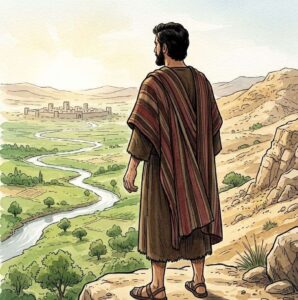
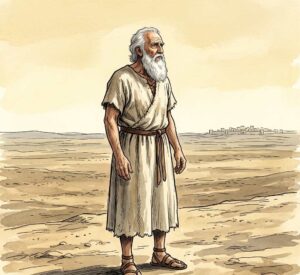
Then a group of them journeyed from the east. They traveled across the plains and the hills, their flocks and herds moving with them, their families walking beside the animals under a sky that had not yet been divided by the sound of different languages. They came to a plain in the land of Shinar, a wide and open country where the soil was rich and the rivers ran slow and the horizon stretched out flat in every direction. And there they stopped. And there they decided to stay.
They said to one another, “Go to, let us make brick, and burn them throughly.” And they had brick for stone, and slime had they for mortar. The words were plain and practical, the talk of builders and planners and men who knew how to shape the raw materials of the earth into something that would last.
The Making of the Bricks
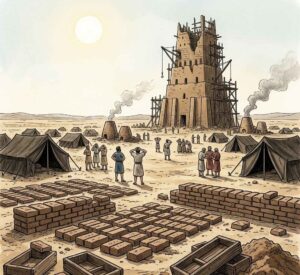
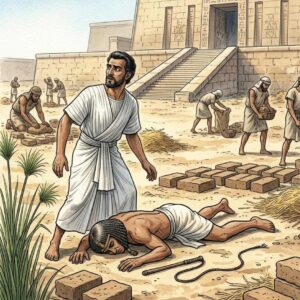
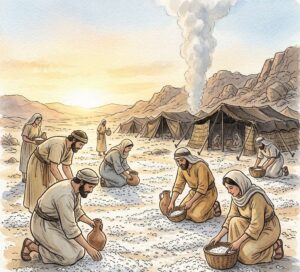
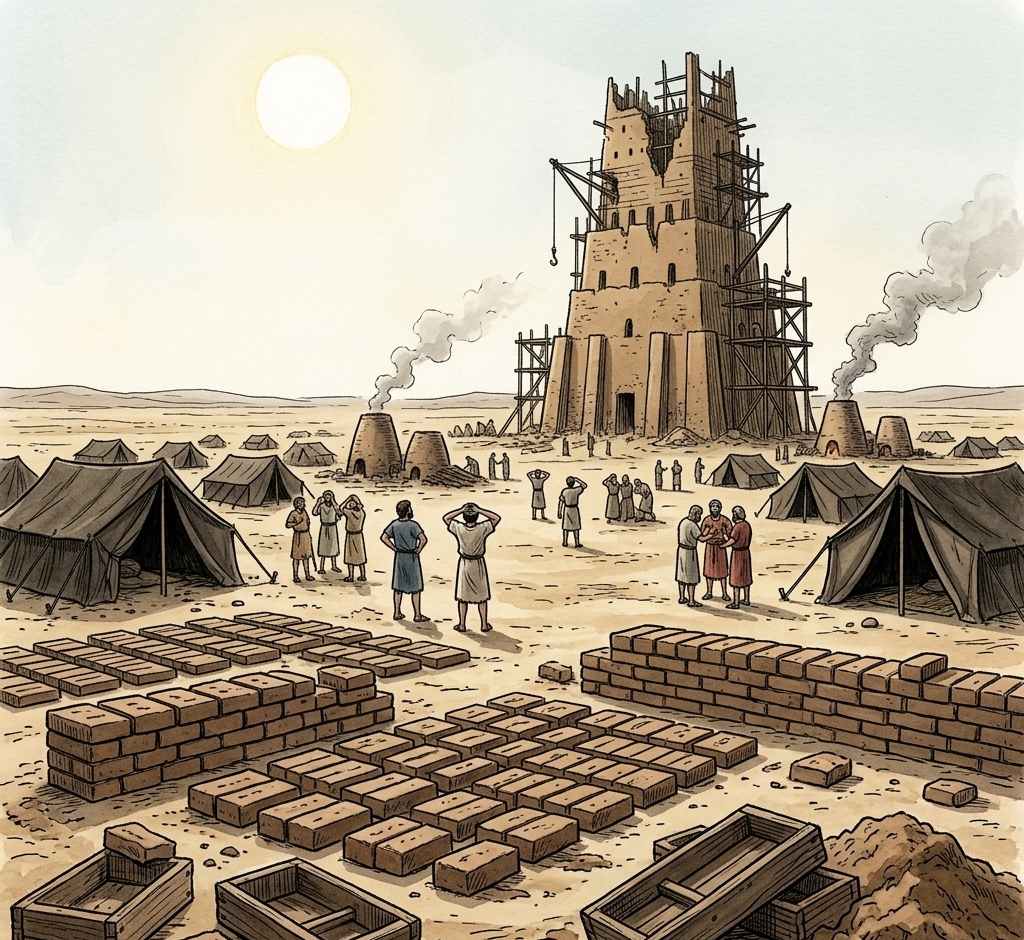
The plain of Shinar had no stone. There were no quarries in the hills, no outcroppings of rock that could be cut and shaped and fitted together. The land was all mud and clay and river silt, soft underfoot, pliable in the hand. So the people did what people do when they lack what they need. They made something new. They dug the clay from the riverbanks and pressed it into wooden molds and carried it to the kilns they had built. And they burned the bricks until they were hard and strong, bricks that could hold weight, bricks that could stack high, bricks that could build something the world had never seen before.
The sun beat down on the plain while the bricks baked. The heat rose from the kilns in shimmering waves. The men worked with their tunics pulled up and their backs bent and their hands caked with dried mud. The women carried water from the river to cool the workers and mix the mortar. The children ran between the rows of drying bricks, their bare feet leaving small prints in the dust. The plain was loud with the sound of labor, the clink of tools, the calls of the foremen, the rhythm of work that had a purpose behind it.
They had brick for stone. That was the invention. Stone was what the earth gave. Brick was what men made. And the men of Shinar were makers. They would not wait for the earth to provide. They would take the clay and the fire and the slime from the pits, and they would build something that reached higher than anything stone could reach.
The Words They Spoke
Then they said, “Go to, let us build us a city and a tower, whose top may reach unto heaven. And let us make us a name, lest we be scattered abroad upon the face of the whole earth.”
The words were not just the talk of builders anymore. They were the talk of men who wanted something more than shelter. A city. A tower. A top that reached to heaven. And a name. They wanted a name for themselves, a name that would be remembered, a name that would hold them together so that they would never be scattered across the face of the earth. The flood had scattered the old world. The waters had covered the cities of the mighty men and wiped their names from the face of the ground. But these men would not be wiped away. These men would build something that no flood could reach, no water could cover, no judgment could erase.
The tower rose from the plain. Brick by brick, layer by layer, the work of thousands of hands lifting and stacking and mortaring, the tower climbed into the sky. It was not a quick work. It was not a small work. It was the work of a generation, a monument to human will and human pride and human fear of being scattered and forgotten. The people looked up at what they were building, and they saw that it was good. They saw that nothing could stop them. They saw that with one language and one purpose, they could do anything they set their minds to do.
The Coming Down
And the Lord came down to see the city and the tower which the children of men builded.
The words are quiet and terrible. The Lord came down. The tower was built to reach unto heaven, but it did not reach heaven. It did not even come close. The Lord had to come down to see it. All the labor and the sweat and the bricks baking under the sun, all the ambition and the pride and the dream of making a name that would last forever, and from the perspective of heaven it was so small that the Lord had to descend to get a good look at it. The highest thing men had ever built was still so low that God had to stoop to examine it.
The Lord looked at the city and the tower. He looked at the people working together, their one language flowing between them like a river. He looked at their unity, their cooperation, their determination. And he said something that rings through the ages.
“Behold, the people is one, and they have all one language. And this they begin to do. And now nothing will be restrained from them which they have imagined to do.”
The Lord did not say they were weak. He said they were strong. He did not say their tower would fall. He said that with one language and one purpose, nothing they imagined would be beyond their reach. The danger was not that they would fail. The danger was that they would succeed. The danger was that human pride, united under a single tongue, would storm the gates of heaven itself and drag the world into a darkness deeper than the flood.
The Confusion
So the Lord did something that only the Lord could do. He did not send a flood. He did not send fire from heaven. He did not shake the ground and topple the tower into the dust. He went down and confounded their language, so that they could not understand one another’s speech.
It happened in a moment. One man opened his mouth and spoke, and the man beside him heard only noise. Words that had been clear were now gibberish. Commands that had been understood were now a jumble of sounds. The foremen shouted instructions, and the workers stared at them with blank faces. The architects drew plans in the dirt, and no one could read them. The language that had united them was shattered into a thousand pieces, and the pieces scattered across the plain like the bricks they had been baking under the sun.
The work stopped. It had to stop. A man cannot build a tower with a neighbor he cannot understand. He cannot pass bricks or mix mortar or raise walls when the words that connect his mind to the mind of the man beside him have been turned into confusion. The tower stood unfinished, its top still far from heaven, its builders wandering away from the work site with their hands hanging at their sides and their ears still ringing with sounds that made no sense.
The Scattering
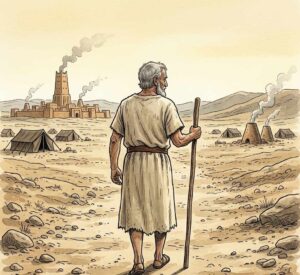
And the Lord scattered them abroad from thence upon the face of all the earth. They left off building the city. The name they had wanted to make for themselves was never made. The tower that was to keep them together became the reason they were driven apart. The plain of Shinar, which had been a place of unity and purpose, became a place of departure. Families gathered their belongings. Clans formed around those who could still understand one another. And they went out, group by group, language by language, into the wide world that they had tried so hard not to be scattered across.
The tower stood behind them, half-built, its top still far from heaven, its bricks slowly cooling in the sun. The kilns went cold. The wooden molds lay abandoned in the dust. The slime pits dried up and cracked. And the name of the place was called Babel, because the Lord did there confound the language of all the earth. The word Babel meant confusion, and confusion was what remained when the builders walked away.
The sun set over the plain of Shinar, and the unfinished tower cast a long shadow across the empty work site. The bricks that had been baked so carefully under the hot sun now sat in stacks that no one would ever use. The city that had been planned so grandly was now only a sketch in the dirt, lines that the wind was already beginning to erase. And the people who had dreamed of making a name for themselves were scattered across the face of the earth, speaking words that their former neighbors could no longer understand.
Beneath the tower, a single brick lay half-buried in the dust. It was hard and well-made, burned throughly in the fire, strong enough to hold any weight. But there was no one left to pick it up and set it in its place. The work was over. The scattering had begun. And the confusion that started at Babel would not be undone until a day far in the future, when men from every nation and tribe and tongue would gather in one place and hear the mighty works of God spoken in their own languages, a reversal of the curse that fell on the plain of Shinar.