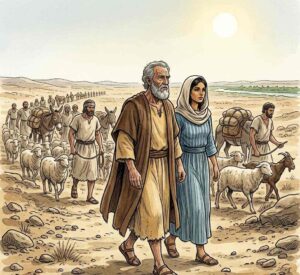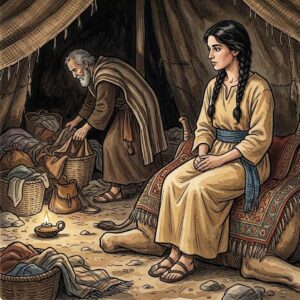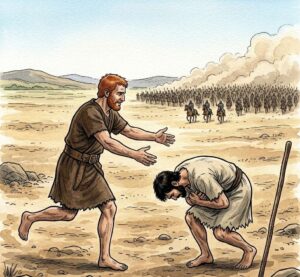

The messengers had returned with terrifying news. Esau was coming with four hundred men. The brother he had cheated twenty years ago, the hunter whose blessing he had stolen, the hairy man whose venison his father loved, was marching toward him with an army at his back. Jacob had sent gifts ahead, waves of goats and sheep and camels and cattle, hoping to appease his brother’s anger. He had divided his camp into two bands, so that if one was attacked the other might escape. He had prayed, reminding the Lord of the promise made at Bethel, the promise of protection and offspring and return to the land of his fathers.
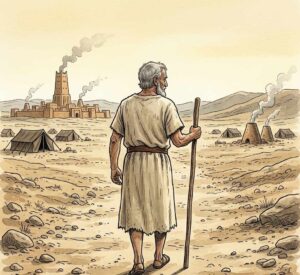
Now the night before the meeting had arrived. Jacob sent his wives and his handmaids and his eleven children across the ford of the Jabbok river, along with all his possessions. The stream rushed through the darkness, the water cold against their legs as they crossed to the other side. When the last figure had disappeared into the night, Jacob was left alone on the near bank. The flocks were gone. The servants were gone. His family was gone. He stood by himself in the darkness, the river behind him, his brother’s army somewhere ahead, and the weight of twenty years pressing on his shoulders.
Then a man appeared out of the darkness and began to wrestle with him.
The Struggle in the Darkness
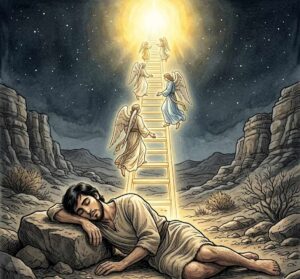
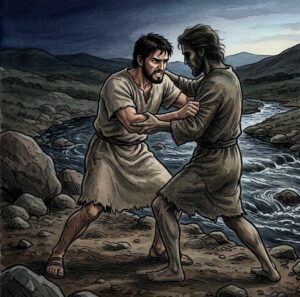
The Scripture gives no warning of the man’s arrival. There was no voice from heaven, no ladder reaching to the sky, no dream with angels ascending and descending. There was only the sudden rush of a body colliding with his own, the grip of hands on his shoulders, the force of an opponent who had come for a fight. Jacob did not call for help. He did not cry out to the Lord. He wrestled.
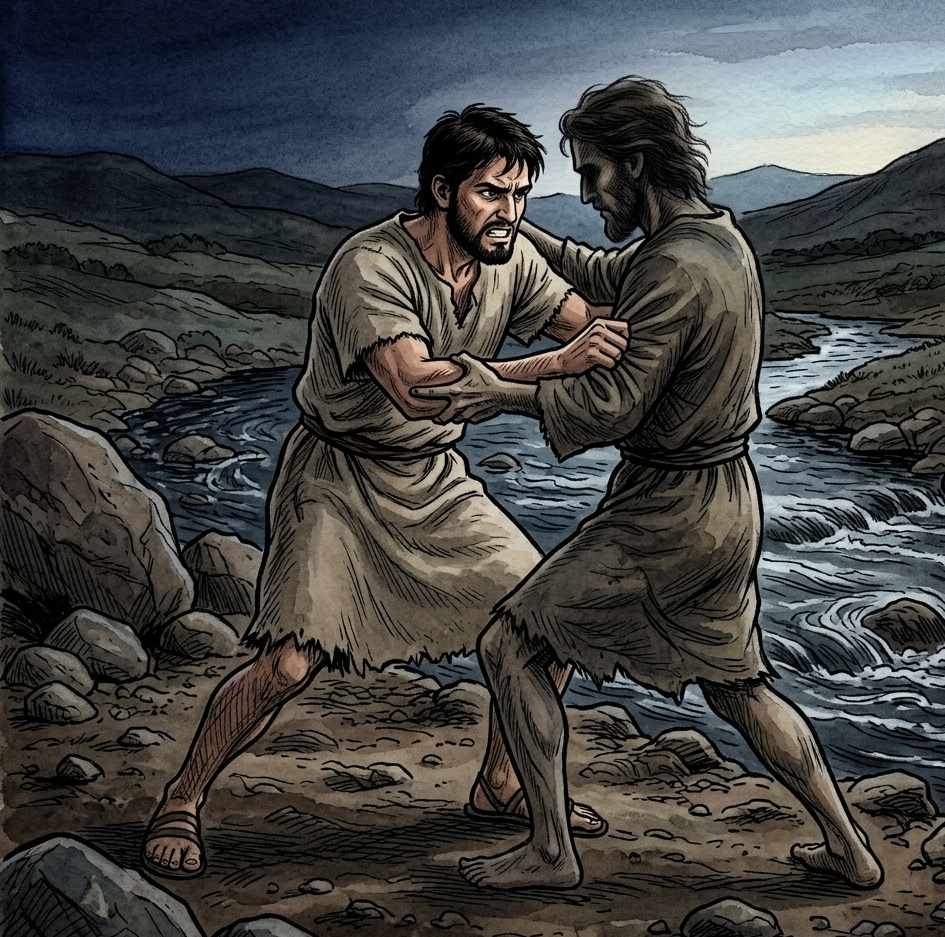
They struggled in the darkness, two figures locked together on the bank of the Jabbok, their feet slipping on the wet stones, their breath coming hard and fast. The man was strong, but Jacob was stubborn. He had spent his life wrestling. He had wrestled with Esau in the womb. He had wrestled with Isaac for the blessing. He had wrestled with Laban for twenty years over wages and flocks and wives. Jacob did not know how to let go. He did not know how to surrender. He did not know how to stop fighting. And so he fought this stranger in the darkness with the same tenacity he had brought to every conflict of his life.
The hours passed. The night wore on. The stars turned in their courses overhead, and still they wrestled. Neither could overcome the other. The man could not throw Jacob down, and Jacob could not break free. They were locked in a stalemate, and the first grey light of dawn was beginning to touch the eastern sky.
Then the man did something strange. He reached out and touched the hollow of Jacob’s thigh. Just a touch. Just the lightest pressure on the socket of the hip. But the touch was enough. The thigh of Jacob went out of joint. The bone slipped from its socket. The pain must have been blinding, a white-hot lance shooting through his body, his leg suddenly useless beneath him. He could no longer stand. He could no longer wrestle. He could only hold on.
The Grip That Would Not Let Go
The man spoke. His voice was calm in the darkness, the voice of one who had been holding back his full strength all along. “Let me go, for the day breaketh.”
Jacob knew now. He knew who he was wrestling with. The touch that had thrown his thigh out of joint was not the touch of an ordinary man. The voice that spoke with such quiet authority was not the voice of a mere stranger. He was holding on to something more than human. He was clinging to the Lord himself, the God of Abraham and Isaac, the God who had promised to be with him and keep him and bring him back to this land. And even in his pain, even with his leg useless and the dawn breaking and his brother’s army marching toward him, Jacob refused to release his grip.
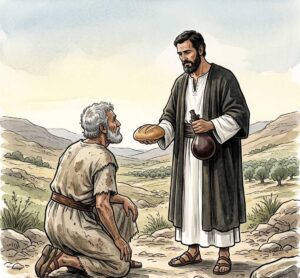
“I will not let thee go, except thou bless me.”
The words were the cry of a man who had reached the end of himself. He could no longer wrestle. He could no longer fight. He could no longer scheme his way to victory. He could only hold on and ask for what he had been chasing his whole life. A blessing. Not a stolen blessing, not a blessing gained by deception and goat skins, but a real blessing, a true blessing, a blessing given freely by the One who had the right to give it.
The man looked at Jacob, clinging to him in the grey dawn light, his leg twisted and useless, his face wet with sweat and tears. And he asked him a question.
“What is thy name?”
The question cut through everything. Jacob. The supplanter. The heel-grabber. The deceiver. The name that had defined his whole life, the name he had lived up to in every relationship and every conflict, was now being asked of him by the One who knew him better than he knew himself. He had lied about his name before. He had stood before his blind father and said, “I am Esau thy firstborn.” But he could not lie now. The man who held him saw through every deception.
“Jacob.”
He spoke his own name. He confessed who he was. The supplanter. The deceiver. The man who had spent his whole life grabbing for blessings that belonged to someone else. And in the speaking of his name, in the admission of his true identity, something broke inside him. The old man was dying. The wrestler was being brought to the end of his strength. And the new man was about to be born.
The New Name
“Thy name shall be called no more Jacob, but Israel. For as a prince hast thou power with God and with men, and hast prevailed.”
Israel. The prince of God. The one who struggles with God and prevails. The name was a new identity, a new future, a new way of being in the world. He had wrestled with God and with men, and he had prevailed. Not because he was strong. Not because he was clever. Not because he deserved to win. But because he had held on and refused to let go. The blessing he had tried to steal from Esau he had finally received the right way. By asking. By clinging. By admitting who he was and trusting in the mercy of the One who held him.
Jacob asked the man his name in return. “Tell me, I pray thee, thy name.”
The man did not give it. “Wherefore is it that thou dost ask after my name?” And he blessed him there. The blessing that Jacob had wrestled for all night, the blessing he had clung to with his broken body, was given. The words are not recorded. The content of the blessing is hidden from us. But Jacob knew what it meant. He had met God face to face, and his life was preserved.
He called the name of the place Peniel, which means the face of God. “For I have seen God face to face, and my life is preserved.”
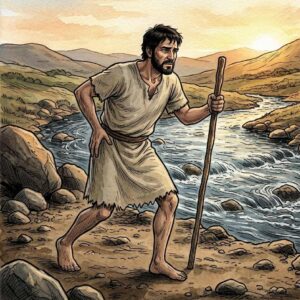
The sun rose over Peniel as Jacob passed over the ford of the Jabbok. He walked with a limp now, his thigh still out of joint, his body marked forever by the touch of the divine. The man who had been the supplanter was now the prince. The deceiver had become the one who prevails with God. And ahead of him, somewhere in the hills of Seir, Esau was coming with four hundred men. But the man with the limp was ready to meet him.