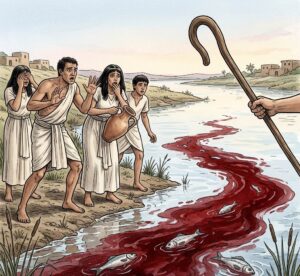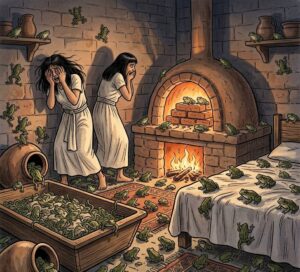

The plagues had fallen one after another, and still Pharaoh would not yield. The water had turned to blood. The frogs had filled the beds and ovens. The lice had crawled from the dust. The flies had swarmed the houses. The cattle had died in the fields. The boils had broken out on man and beast. The hail had shattered the flax and barley. The locusts had eaten what the hail had left. Each plague had brought Egypt closer to ruin. Each plague had been followed by the same hardening of the heart of the king.
Now the Lord spoke to Moses again, and the next plague would need no rod and no warning. It would come directly from the hand of God, and it would strike at the very heart of Egyptian religion.
“Stretch out thine hand toward heaven, that there may be darkness over the land of Egypt, even darkness which may be felt.”
Moses stretched forth his hand toward heaven. The command had been given without a visit to Pharaoh, without a demand for release, without a warning of what was coming. The time for negotiation had passed. The judgment would fall without announcement, and the king would sit in the darkness and know that the Lord of the Hebrews was God.
The Darkness Falls
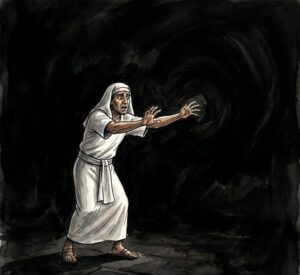
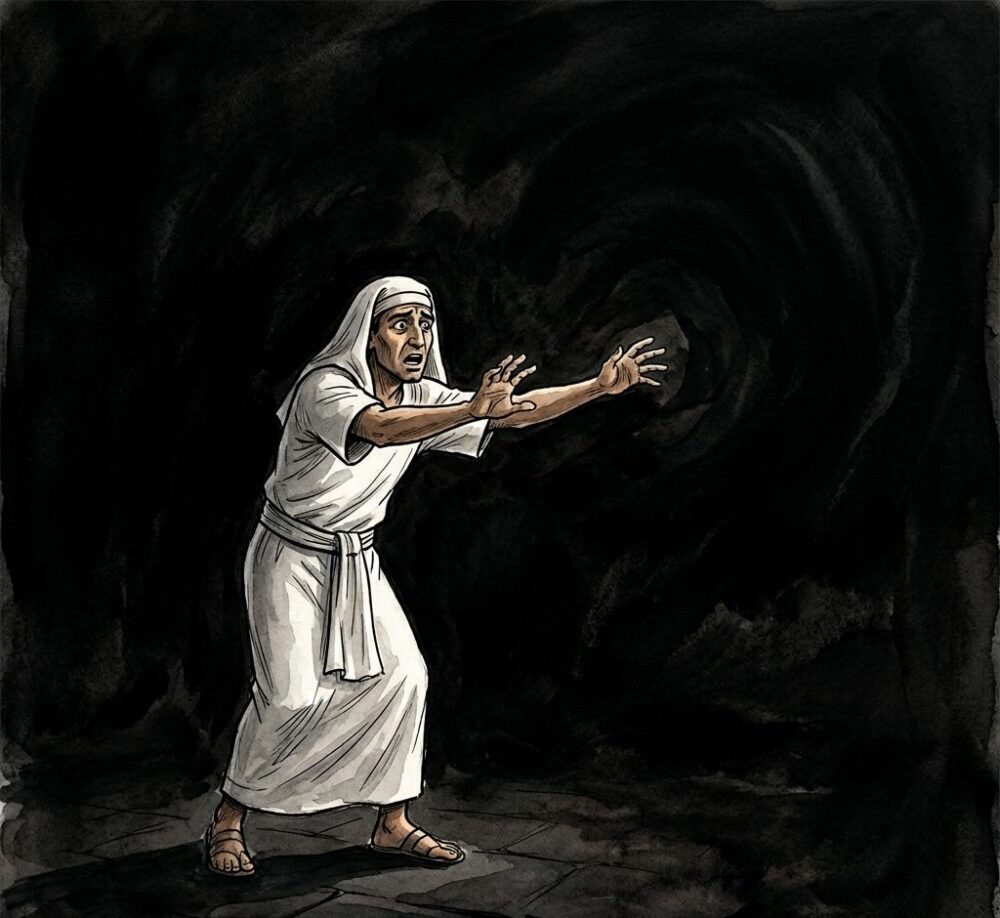
The darkness came upon the land of Egypt. It did not come like the gradual fading of evening. It did not come like the shadow of a storm cloud passing over the sun. It came as a thick darkness, a darkness that could be felt, a darkness that pressed against the skin like a heavy cloth. The Egyptians reached out their hands and touched the darkness, and it was solid against their fingers. It was a darkness that filled the mouth and the nostrils, a darkness that seemed to have weight and substance.
The sun did not rise. Ra, the sun god, the chief deity of the Egyptian pantheon, was silent. The god whom Pharaoh claimed to represent, the god whose image was carved on every temple and whose name was invoked in every ritual, was powerless before the Lord of Israel. The darkness was a direct assault on the heart of Egyptian worship, a declaration that the God of the Hebrews controlled the heavens in ways that the gods of Egypt could not match.
They saw not one another. The words are simple and terrifying. The Egyptians were isolated in the darkness, cut off from their families, their neighbors, their servants. A husband could not see his wife beside him. A mother could not see her child in her arms. The voices of the people called out through the blackness, but no one could find the source of the cries. The darkness swallowed sight and sound and hope.
Neither rose any from his place for three days. The Egyptians sat where they were when the darkness fell. They did not move because they could not move. The darkness was so complete that walking meant injury or death. A step could lead to a fall. A journey to the door could end in disaster. The people sat in their houses, in their shops, in their temples, and they waited. The three days passed like an eternity. Time itself seemed to stop in the blackness that covered the land.
The Light in Goshen
But all the children of Israel had light in their dwellings. In the land of Goshen, where the Hebrews lived, the sun continued to shine. The darkness that crushed Egypt stopped at the borders of the slave quarter. The women of Israel kneaded their dough by the light of the day. The children played in the streets under a clear sky. The men tended their flocks and saw the sun rise and set as it had always done.
The division was absolute and undeniable. The Lord was drawing a line between his people and the people of Egypt. The same darkness that tormented the oppressors was a comfort to the oppressed. The same plague that demonstrated judgment on Egypt demonstrated protection on Israel. The Hebrews looked toward the land of their masters and saw only blackness. The Egyptians looked toward the land of their slaves and saw light. The message was clear. The God of Abraham knew where his people were, and he would not let the judgment fall on them.
The Egyptians could not see the light in Goshen from their prison of darkness. They could only sit in the blackness and imagine what it meant that the slaves had light while the masters had none. The reversal was complete. The Hebrews who had been forced to work in the darkness of the brick pits now walked in the light. The Egyptians who had worshiped the sun god now groped in the darkness like blind men.
The Summons
Pharaoh called for Moses at the end of the three days. The king who had refused every demand now sent his servants stumbling through the darkness to find the man who had brought the plague. The message was a surrender wrapped in a condition.
“Go ye, serve the Lord. Only let your flocks and your herds be stayed. Let your little ones also go with you.”
The offer was a compromise. Take your families. Go worship your God. But leave your wealth behind. Leave your flocks and your herds as a guarantee that you will return to your slavery. Pharaoh was still trying to control the terms of the release, still trying to keep his grip on the labor force that built his cities and worked his fields.
Moses refused. “Thou must give us also sacrifices and burnt offerings, that we may sacrifice unto the Lord our God. Our cattle also shall go with us. There shall not an hoof be left behind. For thereof must we take to serve the Lord our God. And we know not with what we must serve the Lord, until we come thither.”
The demand was total. Not a hoof would remain in Egypt. The entire nation would go, with all their possessions, to worship the Lord in the wilderness. Moses did not know what sacrifices would be required. He did not know how many animals would be needed. He only knew that the Lord had commanded the release of his people, and nothing less than total release would satisfy the command.
The heart of Pharaoh hardened again. The darkness had lifted. The sun had returned to the sky. The three days of terror were over, and the king’s resolve returned with the light. He looked at Moses with fury and spoke words that would seal the fate of his firstborn son.
“Get thee from me. Take heed to thyself, see my face no more. For in that day thou seest my face thou shalt die.”
Moses answered him, and his words were the final prophecy before the final plague. “Thou hast spoken well. I will see thy face again no more.”
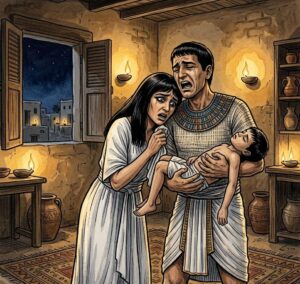
The servant of the Lord turned and left the presence of the king. Behind him, Egypt was still reeling from the darkness that could be felt. Ahead of him, the last and most terrible plague was being prepared. The angel of death was sharpening his sword. The midnight cry was drawing near. And Pharaoh would soon know, in the most terrible way, what it meant to refuse the Lord of Israel.