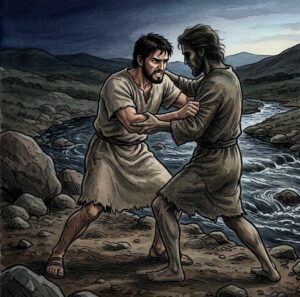

The boys had been fighting since they were in the womb. Rebekah felt them struggling within her, two lives wrestling in the darkness, and she asked the Lord what was happening to her. The answer came back hard and clear. Two nations were in her womb. Two manner of people would be separated from her body. One would be stronger than the other, and the elder would serve the younger.
When the time came for her to deliver, the firstborn came out red, all over like a hairy garment, and they called his name Esau. After that his brother came out, and his hand took hold of Esau’s heel, and they called his name Jacob, which means supplanter, heel-grabber, the one who seizes what belongs to another.
The boys grew. Esau became a cunning hunter, a man of the field, his hands rough from the bow and the knife, his skin dark from the sun. He loved the open country. He loved the chase. He loved the smell of wild game roasting over an open fire. His father Isaac loved him, because he did eat of his venison, the rich meat that Esau brought back from the hunt.
Jacob was different. He was a plain man, dwelling in tents. He stayed close to home, close to his mother, close to the flocks and the cooking fires and the familiar paths around the camp. He was quiet where his brother was loud, still where his brother was restless, patient where his brother was impulsive. The two brothers moved through the same household like water and oil, never mixing, always rubbing against each other.
The Hunter Comes Home Empty
One day Esau came in from the field. He had been hunting, but the hunt had yielded nothing. No deer crossed his path. No wild goat fell to his arrow. He had chased through the hills and the valleys until his legs were weak and his mouth was dry and his stomach was a hollow pit gnawing at his insides. He was faint. The Scripture says he was faint, and the word means more than tired. It means emptied, drained, a man whose strength had run out like water poured on sand.
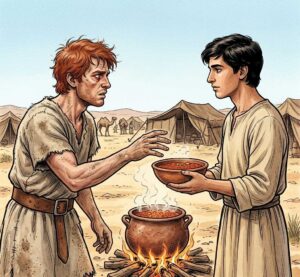
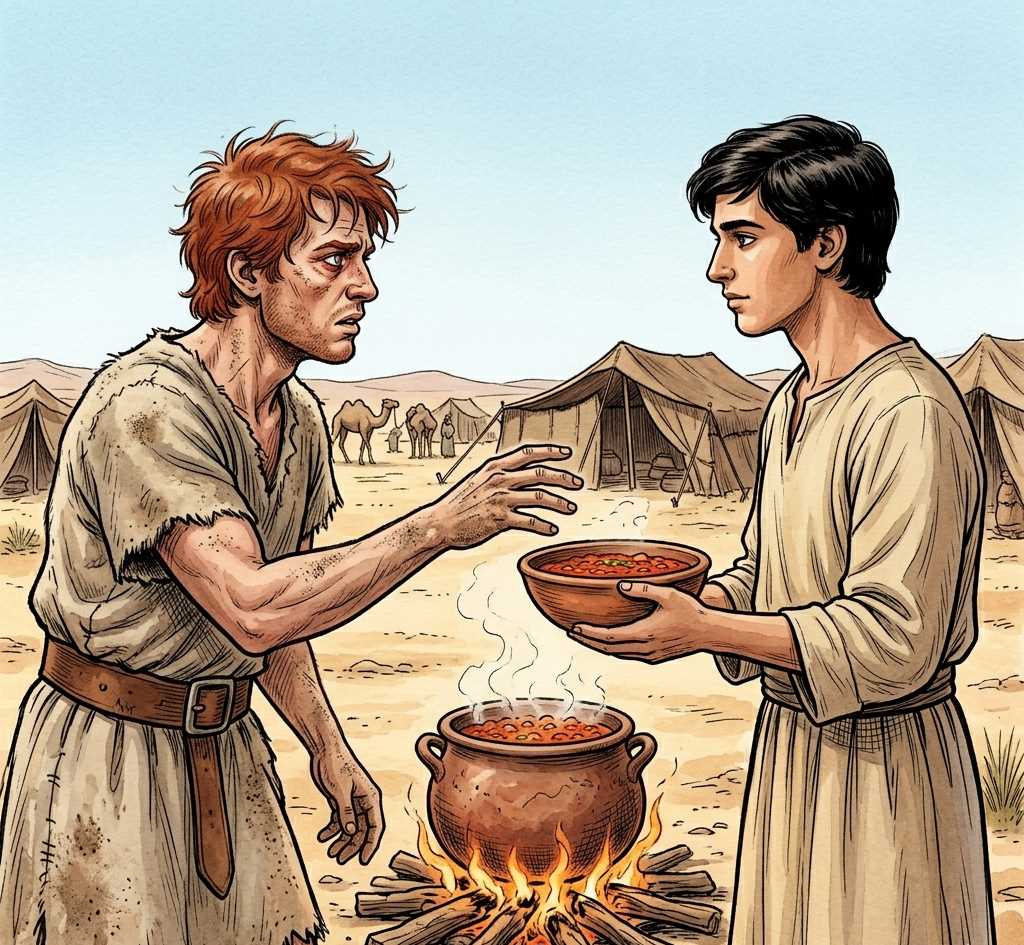
Jacob was at the cooking fire. A pot was bubbling over the flames, and the smell of it filled the air around the tents. Red stew. Red lentils simmering in water with salt and herbs, the steam rising in the afternoon heat. The color was deep and rich, the color of the earth after rain, the color of blood, the color of the son who had come out of the womb covered in red.
Esau smelled it. The smell hit him like a blow, and his hunger sharpened into something desperate. He stood at the edge of the cooking area, his hunting clothes still dusty from the field, his bow hanging loose in his hand, his eyes fixed on the pot. He could think of nothing else. The red stew was all he could see, all he could smell, all he could want.
“Feed me, I pray thee, with that same red pottage. For I am faint.”
The words came out in a rush, the plea of a man who had reached the end of his strength. He did not ask for bread. He did not ask for water. He asked for the red stew, the red pottage, the thing that was right in front of him, steaming and fragrant and ready to eat.
Jacob looked at his brother. The quiet man who dwelt in tents saw the hunter reduced to begging, the firstborn brought low by an empty stomach. And he saw his opportunity.
“Sell me this day thy birthright.”
The Price of the Bowl
The birthright. The right of the firstborn son. A double portion of the inheritance. The leadership of the family. The blessing of the father. The place of honor in the household of Isaac and the line of Abraham. The birthright was worth more than flocks and herds and gold. It was the future. It was the promise. It was the covenant that God had made with Abraham and passed down to Isaac, the covenant that would carry the seed of blessing to all the nations of the earth.
Jacob was asking for it in exchange for a bowl of stew.
Esau did not hesitate. He did not argue. He did not consider the weight of what he was giving up. The red stew was before him, and his hunger was upon him, and the present moment swallowed up all thought of the future.
“Behold, I am at the point to die. And what profit shall this birthright do to me?”
The words were dramatic, the exaggeration of a man who let his appetite speak for him. He was not at the point of death. Hunters miss meals. Men go hungry and survive. But Esau had never learned to deny himself anything he wanted, and now his want was so loud that he could hear nothing else. The birthright seemed like a distant, intangible thing compared to the steaming bowl before his eyes. What good was an inheritance if he died of hunger? What good was a future he might not live to see?
Jacob pressed him. “Swear to me this day.”
And Esau swore to him. He swore an oath, a binding promise before God, that his birthright now belonged to Jacob. The firstborn sold his inheritance for a bowl of red stew. The hunter traded his future for a meal that would be gone in minutes. The son of Isaac, the grandson of Abraham, the heir of the promise, gave it all away because he was hungry and the stew was red and the smell was more than he could resist.
The Meal and the Aftermath
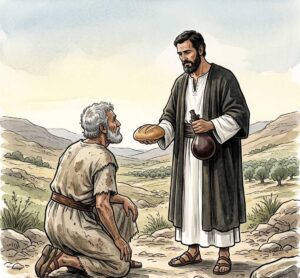
Jacob gave him bread and pottage of lentils. Esau sat down and ate and drank. The stew was hot and filling. The bread soaked up the last of the red liquid in the bowl. When he was finished, he rose up and went his way. The meal was over. The hunger was gone. And the birthright was gone with it.
The Scripture says that Esau despised his birthright. The word is sharp and final. He did not simply sell it. He did not simply trade it. He despised it. He treated it as worthless. He valued a bowl of stew more than the blessing of God that had been passed down from Abraham to Isaac. The hunter who loved the field and the chase and the meat of wild game had no room in his heart for the things of the promise.
Jacob watched his brother walk away. The bowl was empty. The fire was dying down. The quiet man who dwelt in tents now held the birthright of the firstborn. He had bought it for the price of a meal, but the cost to Esau would echo through generations. The writer of the letter to the Hebrews would later hold him up as a warning, a profane person who for one morsel of meat sold his birthright, and afterward, when he would have inherited the blessing, he was rejected. For he found no place of repentance, though he sought it carefully with tears.
The red stew was gone. The birthright was gone. And Esau walked back into the field, his belly full and his inheritance empty, the first of many sorrows that would follow him all the days of his life.