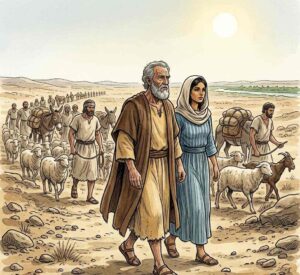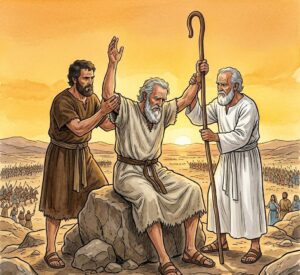

Jacob had fled across the river. While Laban was away shearing his sheep, Jacob had gathered his wives and his children and his flocks and his goods and set out for the land of Canaan. He did not tell his uncle he was leaving. He simply went, slipping away like a man escaping from a prison, driving his herds before him toward the hills of Gilead.
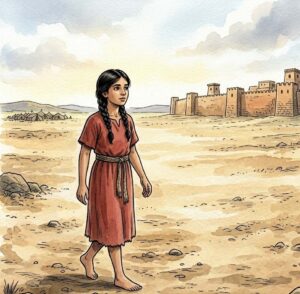
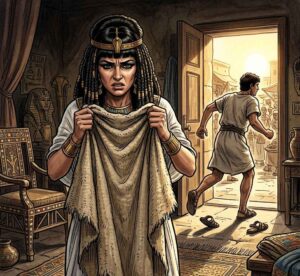
But someone else had taken something in secret. Rachel had gone into her father’s tent while he was away, and she had stolen the household gods.
The teraphim. The small idols that stood in the house of Laban, the images that represented the gods of his ancestors, the deities of the land beyond the river. They were small enough to hide, valuable enough to steal, significant enough that Laban would pursue a fleeing son-in-law across the desert to get them back. Rachel had taken them, and she had told no one. Not her husband. Not her sister. The secret was hers alone, and she carried it with her as the caravan moved westward.
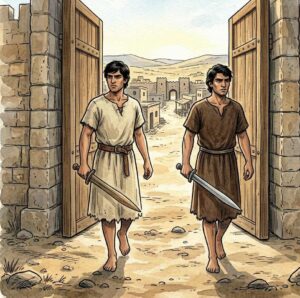
Three days passed before Laban discovered that Jacob was gone. He gathered his brethren and pursued him for seven days, chasing the long train of camels and flocks and women and children across the wilderness. He caught up with them in the mount of Gilead, where Jacob had pitched his tents. The confrontation was tense, two armies facing each other in the hills, but God came to Laban in a dream by night and warned him, “Take heed that thou speak not to Jacob either good or bad.”
Laban came to Jacob with words of wounded pride. “What hast thou done, that thou hast stolen away unawares to me, and carried away my daughters, as captives taken with the sword? Wherefore didst thou flee away secretly, and steal away from me, and didst not tell me, that I might have sent thee away with mirth, and with songs, with tabret, and with harp? And hast not suffered me to kiss my sons and my daughters? Thou hast now done foolishly in so doing.”
Then he asked the question that had driven him across the desert. “And now, though thou wouldest needs be gone, because thou sore longedst after thy father’s house, yet wherefore hast thou stolen my gods?”
The Search of the Tents
Jacob knew nothing of the theft. He answered Laban with righteous indignation. “With whomsoever thou findest thy gods, let him not live. Before our brethren discern thou what is thine with me, and take it to thee.”
The words were spoken in innocence, but they were a death sentence waiting to fall. Jacob did not know that his beloved Rachel had taken the gods. He did not know that the wife he loved more than any other was the thief. And he had just sworn an oath that whoever had stolen the teraphim would die.
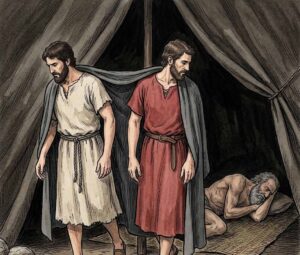
Laban began his search. He went into Jacob’s tent first, the tent of the patriarch, looking for his gods among the belongings of the man he had cheated for twenty years. He found nothing. He went into Leah’s tent next, the tent of the unloved wife, searching through her possessions while her children watched. He found nothing. He went into the tent of the two maidservants, Bilhah and Zilpah, the women who had borne sons for Jacob when his wives could not. He found nothing.
Then he came to the tent of Rachel.
The Woman on the Camel Saddle
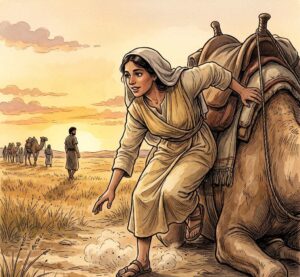
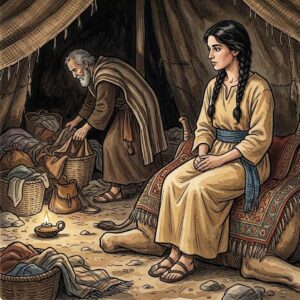
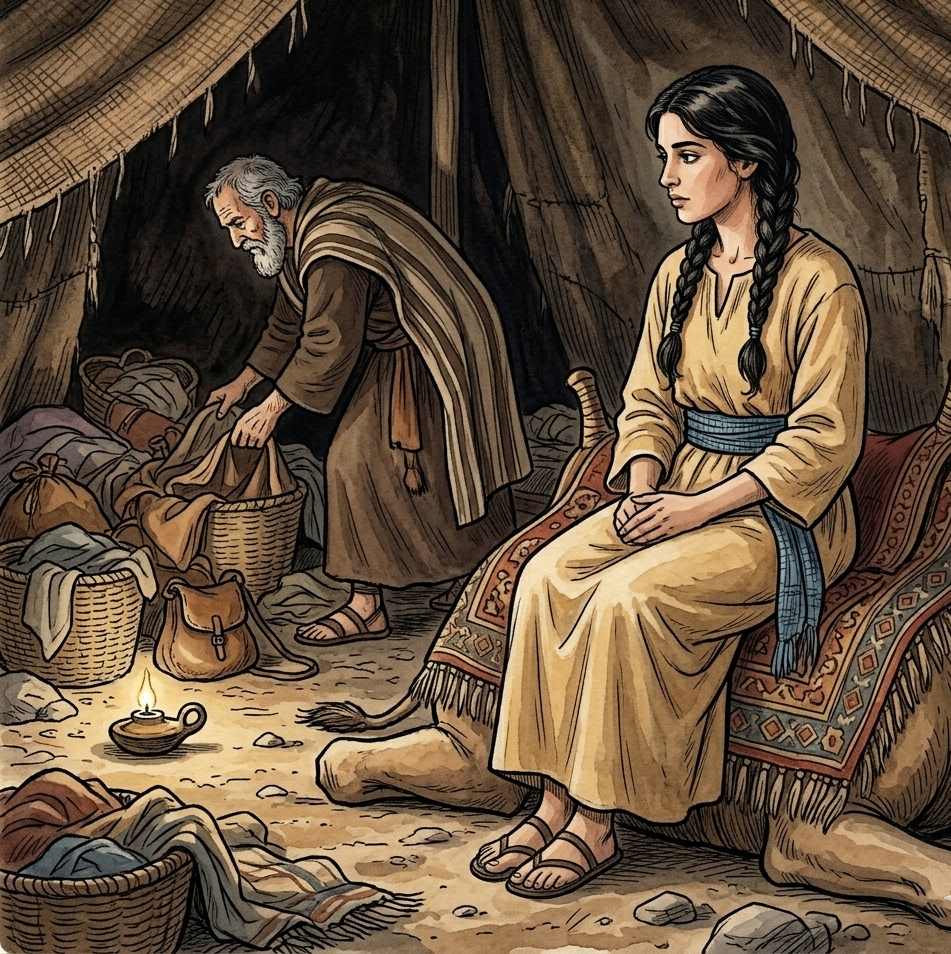
Rachel had taken the images and put them in the camel’s furniture, the saddle or the cushion that served as a seat on the back of the camel. The teraphim were hidden inside the padding, concealed from view, tucked away where no one would think to look. And she sat on them.
She sat on the household gods of her father, the idols she had stolen from his tent, the images that represented the old gods of Mesopotamia, the deities that had no power to bless or curse but still held some pull on her heart. She sat on them and waited for her father to come searching.
Laban entered her tent. He searched through every corner, every basket, every fold of fabric. He was thorough, driven by the loss of his gods, the theft that had brought him across the desert in pursuit. But he did not find them. Rachel remained seated on the camel’s furniture, her face composed, her hands folded in her lap. She did not rise. She did not offer to help. She simply sat there, the stolen idols beneath her, her father searching in vain.
Then she spoke.
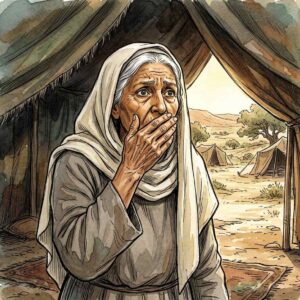
“Let it not displease my lord that I cannot rise up before thee. For the custom of women is upon me.”
The words were a brilliant deception. She claimed she was in the time of her monthly cycle, the period of ritual uncleanness according to the customs of the ancient world. A man would not touch a woman in that condition. A father would not ask his daughter to rise from her seat. The custom of women was upon her, and Laban could do nothing but accept her explanation and move on.
He searched and found nothing. The gods were beneath her, hidden by her own body, protected by a lie that used the very laws of nature as a shield. Rachel had learned deception from her husband and her father both. She had grown up in a house of tricksters, and she had become one herself.
The Parting
Jacob was angry now. His innocence had been proven, and his uncle had humiliated him before his entire household. He poured out twenty years of frustration in a torrent of words. “What is my trespass? What is my sin, that thou hast so hotly pursued after me? Whereas thou hast searched all my stuff, what hast thou found of all thy household stuff? Set it here before my brethren and thy brethren, that they may judge betwixt us both.”
He spoke of his years of service. The flocks he had tended in the heat of the day and the cold of the night. The animals that had been torn by wild beasts, and he had borne the loss himself. The wages that had been changed ten times. The twenty years of labor that had earned him nothing but the wives and children he was taking home. “Except the God of my father, the God of Abraham, and the fear of Isaac, had been with me, surely thou hadst sent me away now empty. God hath seen mine affliction and the labour of my hands, and rebuked thee yesternight.”
Laban had no answer. The gods he had come to find were still hidden, and the God of Jacob had spoken to him in a dream. He could do nothing but make a covenant of peace. He and Jacob gathered stones and built a pillar, a heap of witness between them, a boundary that neither would cross to harm the other. They called it Galeed, the heap of witness, and Mizpah, the watchtower. “The Lord watch between me and thee, when we are absent one from another.”
They ate together on the mountain. They swore an oath before God. And in the morning, Laban rose up, kissed his sons and his daughters, blessed them, and went his way back to Haran. He never saw his daughters again. He never found his gods.
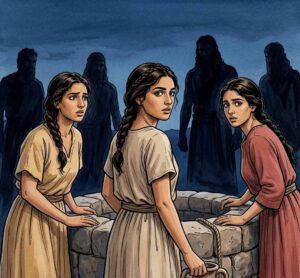
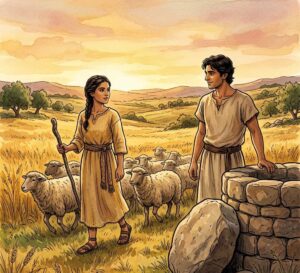
Rachel rose from the camel’s furniture. The teraphim were still there, hidden in the padding, the idols she had stolen from her father’s house. She had sat on them and lied, and the lie had worked. She was the beloved wife of Jacob, the beautiful shepherdess he had kissed at the well, the woman for whom he had worked fourteen years. And she was also the thief who carried the old gods into the new land, a secret that would remain hidden in the baggage of the promise.