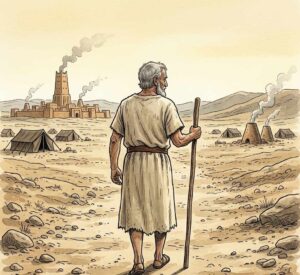
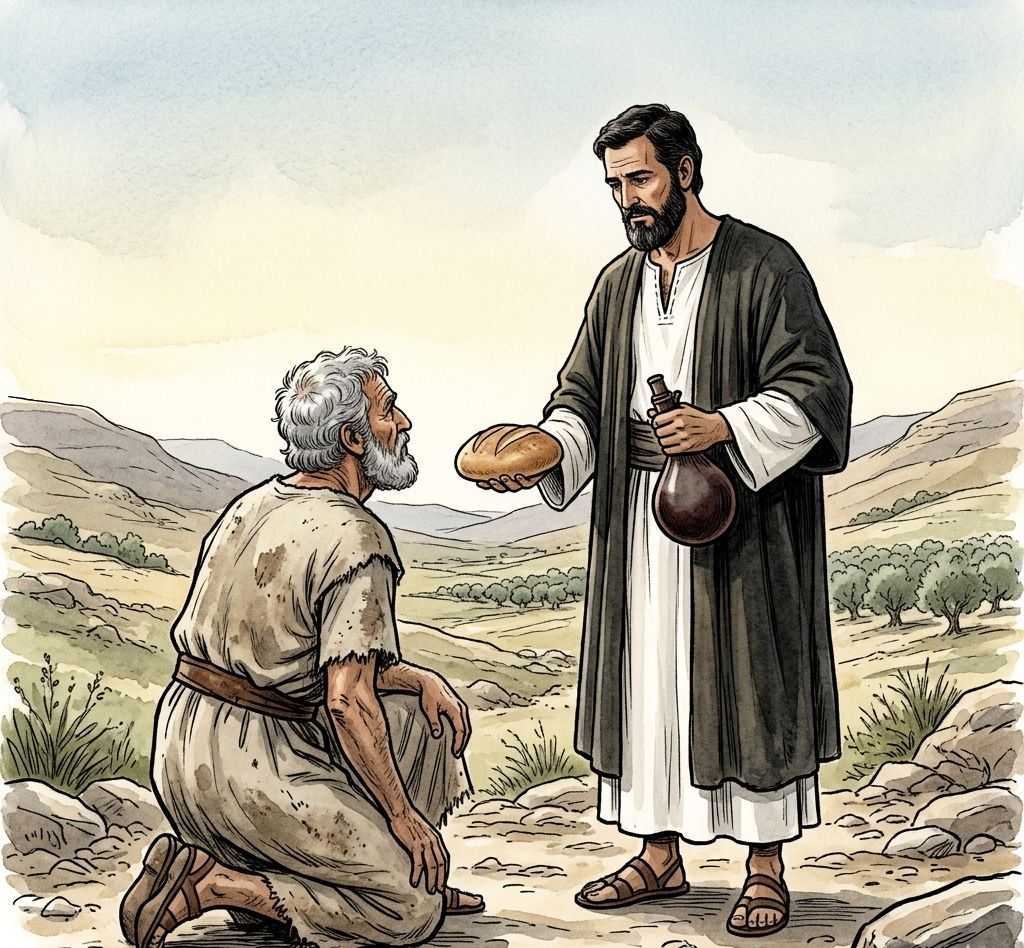

The messenger came running through the hills to Hebron, to the plain of Mamre where Abram lived among the oaks. He brought word that the eastern kings had swept down through the valley of the Jordan and defeated the armies of the plain. They had taken everything. The goods. The food. The people. And among the captives was Lot, the nephew of Abram, the man who had pitched his tent toward Sodom and then moved inside the city walls.
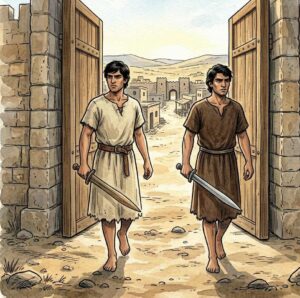
Abram did not wait. He armed his trained servants, three hundred and eighteen men born in his own household, and he called his allies Mamre and Eshcol and Aner, and they set out in pursuit. They marched north through the night, moving fast and silent, and they caught up with the eastern kings at Dan. Abram divided his men and attacked in the darkness, striking the enemy from two sides at once. The eastern armies broke and ran. Abram chased them all the way to Hobah, north of Damascus, and he brought back everything. The goods. The food. The people. And Lot his nephew, walking free again, saved by the uncle he had left behind in the rocky hills.
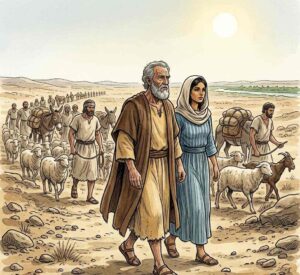
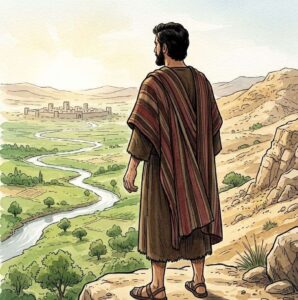
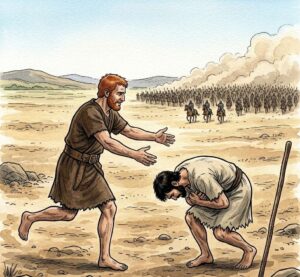
The return journey was long. Abram and his men came back through the valley, driving the recovered flocks and herds before them, the rescued people of the plain following behind. When they reached the valley of Shaveh, which is the king’s dale, the king of Sodom came out to meet him. And after him came another king.
The Priest in the Valley
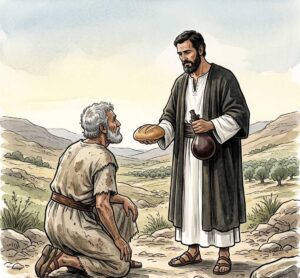
His name was Melchizedek, and he was the king of Salem and a priest of the Most High God. He came out of the city that would one day be called Jerusalem, walking down from the hills into the valley to meet Abram. He carried bread in his hands and wine, and he brought them to the weary warrior who was returning from the battle.
This king was not like the king of Sodom. The king of Sodom ruled a city whose name was a stain on the earth, a place where wickedness rose to heaven like smoke from a furnace. But the king of Salem came as a servant of the Most High God. He wore no crown that Scripture records. He brought no army. He offered no treaty. He brought only bread and wine and a blessing, and Abram received all three as if he had been waiting his whole life for a priest to appear.
The Scripture gives no introduction to this man. He appears without warning, without lineage, without a record of his birth or his death. He steps onto the page in the valley of Shaveh, and he will step off again almost as quickly, leaving behind only a name and a blessing and the taste of bread and wine. But his appearance is not random. He came as a priest before there was a priesthood, a king of righteousness before there was a throne of David, a minister of bread and wine before there was a table in the tabernacle.
Melchizedek did not come empty-handed. He brought bread and wine to the man who had been chasing armies through the night. Abram was coming back from a battle that had stretched over days and nights, and Melchizedek met him in the valley with the simplest things in the world. Bread. Wine. And a blessing spoken over the dust of the road.
The Blessing
“Blessed be Abram of the most high God, possessor of heaven and earth. And blessed be the most high God, which hath delivered thine enemies into thy hand.”
The words of Melchizedek were careful and precise. He blessed Abram first, and then he blessed the God who had given Abram the victory. The order mattered. The blessing on the man was rooted in the blessing on the God who had fought for him. Abram had not won the battle by his own strength. The three hundred and eighteen men had not won it by their own swords. The Most High God, the possessor of heaven and earth, had delivered the enemy into the hand of Abram, and Melchizedek came to name that truth in the presence of the rescued captives and the defeated kings.
The name Most High God was a name that reached beyond the borders of Canaan. It declared that the God of Abram was the God of all things, the owner of heaven and earth, the one who held every king and every kingdom in his hand. The eastern kings had come with their armies and their swords and their pride, and they had been swept away. The kings of the plain had been routed and plundered. But the Most High God had given the victory to a wandering shepherd with a household army, and Melchizedek stood in the valley and called that victory by its true name.
The Tithe
Abram took the bread and the wine. He ate and he drank, and then he did something that showed he understood exactly who Melchizedek was and what the blessing meant. He gave him tithes of all. A tenth of everything he had taken from the eastern kings, the spoils of the battle, the wealth recovered from the routed armies, Abram gave it to this priest-king who had come out of Salem with bread and wine and a word from the Most High God.
The giving of the tithe was an act of worship. Abram was acknowledging that the victory belonged to God, that the spoils belonged to God, that everything he had and everything he was belonged to the Most High who had called him out of Ur and promised him a land and a seed and a blessing for all the families of the earth. He gave a tenth to Melchizedek because Melchizedek was the priest of the God who had made the promise, and the tithe was the sign that Abram believed the promise was still true even after the battle, even after the bloodshed, even after the long road home.
The writer of the letter to the Hebrews would later make much of this moment. He would point out that Levi, the father of the priestly tribe, was still in the loins of Abraham when Melchizedek met him in the valley, and that Levi paid tithes through Abraham to a priest who was greater than any priest of the line of Aaron. The priesthood of Melchizedek was older than the law. It was deeper than the tabernacle. It reached back to a time before Moses, before Israel, before the covenant at Sinai, and it pointed forward to a priest who would come after the order of Melchizedek, a priest who would offer bread and wine and call it his body and his blood.
The King of Sodom
While Melchizedek blessed Abram, the king of Sodom stood nearby and watched. This was the other king who had come to the valley, the ruler of the wicked city whose people had been taken captive and then rescued by a man who owed them nothing. He had seen his own deliverance, and he had seen the priest of the Most High God bless the man who had saved him. And now he spoke.
“Give me the persons, and take the goods to thyself.”
The offer was generous by the standards of the world. Take the wealth, the king of Sodom said. Keep the spoils for yourself. Just give me back the people. But Abram had just given a tenth of everything to Melchizedek. He had just acknowledged that the Most High God was the possessor of heaven and earth, the true owner of every coin and every flock and every life. And he would not let the king of Sodom be the one who made him rich.
“I have lift up mine hand unto the Lord, the most high God, the possessor of heaven and earth, that I will not take from a thread even to a shoelatchet, and that I will not take any thing that is thine, lest thou shouldest say, I have made Abram rich. Save only that which the young men have eaten, and the portion of the men which went with me, Aner, Eshcol, and Mamre. Let them take their portion.”
The words of Abram were a wall between himself and the king of Sodom. He would take nothing from a wicked city. Nothing. Not a thread. Not a sandal strap. His wealth came from the Most High God, and he would let no one say that Sodom had made Abram rich. The bread and wine of Melchizedek had strengthened him for this refusal. The blessing had reminded him who he belonged to. And the tithe had declared where his true treasure lay.
The Departure
And then Melchizedek was gone. He stepped back into the silence from which he had come, walking up the road toward Salem with the tithe of Abram in his hands and the blessing of the Most High God on his lips. The Scripture records nothing more of him in the book of Genesis. No further appearances. No record of his death. No mention of his sons or his successors. He came out of the city of peace with bread and wine, and he returned to it, and the door of history closed behind him.
But the bread and the wine remained. The blessing remained. The tithe remained. And the pattern had been set. A priest who was also a king. A sacrifice of bread and wine. A blessing spoken over the weary. A tithe given in worship. All of it in a valley outside a city that would one day see another king ride in on a donkey, another priest offer himself as a sacrifice, another table spread with bread and wine for the weary children of Abraham.
Abram watched Melchizedek walk away up the road toward Salem, and then he turned back to his tents at Mamre. The rescued people of the plain went home with the king of Sodom. Lot went with them, back to the city that was ripening for judgment. And the valley was quiet again, the dust settling on the road where a priest-king had stood with bread and wine and blessed the man who believed the promise.