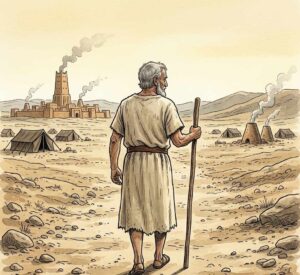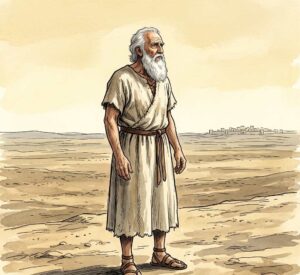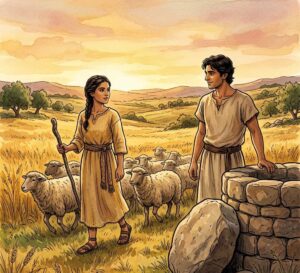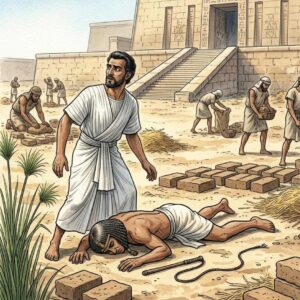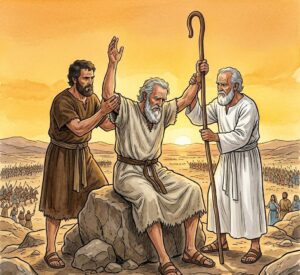

Moses kept the flock of Jethro his father in law, the priest of Midian. Forty years had passed since he fled from Egypt, his hands still stained with the blood of the Egyptian he had killed, his heart still carrying the weight of the Hebrew he had tried to defend. The prince of Egypt had become a shepherd in the wilderness. The man who had walked the halls of Pharaoh’s palace now walked the rocky paths of Horeb, leading his flock through the dry valleys and up the mountain slopes in search of grass and water.
He led the flock to the backside of the desert, to the mountain of God. The place had no special name then. It was simply a mountain in the wilderness of Sinai, a peak of granite and sandstone rising from the barren landscape. The sheep grazed on the sparse vegetation while Moses watched the horizon, the same horizon he had watched for four decades, the endless sameness of rock and sky and sun.
Then the angel of the Lord appeared to him in a flame of fire out of the midst of a bush.
The Flame in the Desert
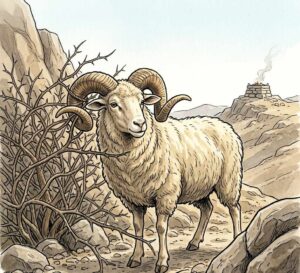
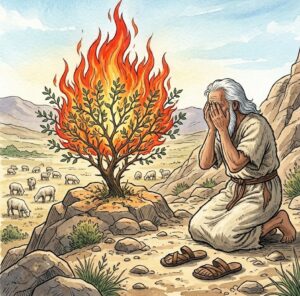
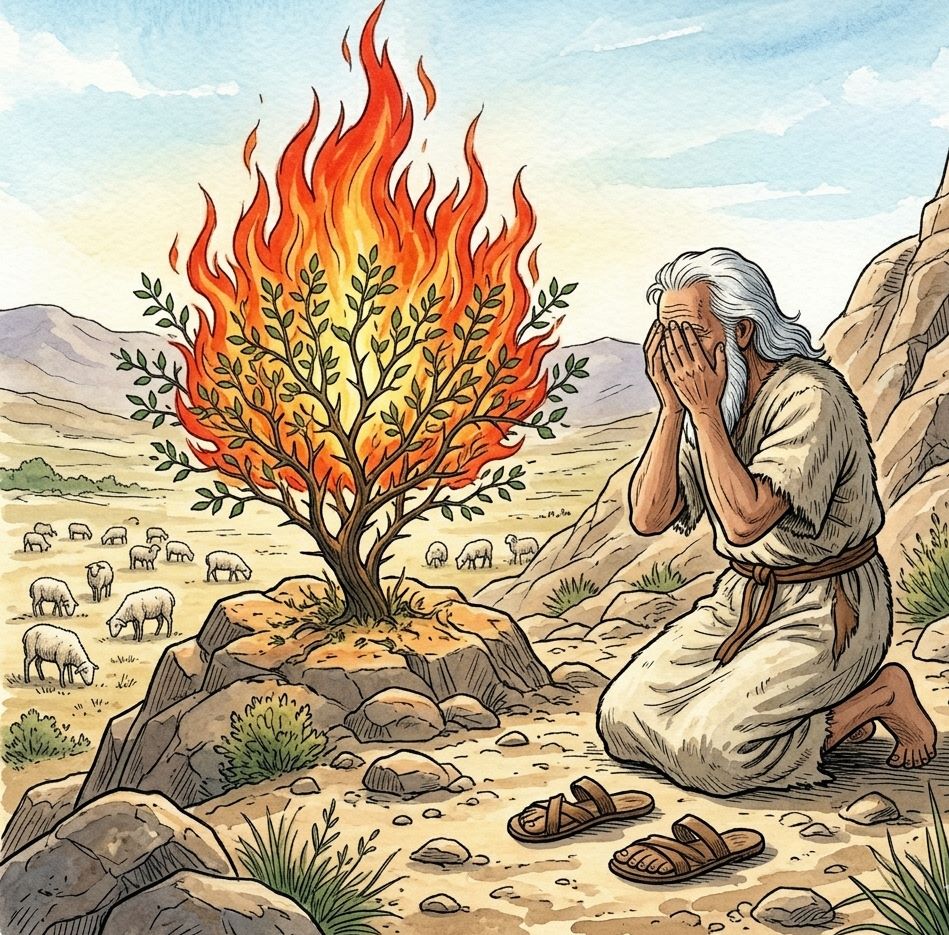
Moses looked, and behold, the bush burned with fire, and the bush was not consumed. The flame danced among the branches, bright and fierce, but the leaves did not blacken. The twigs did not crumble to ash. The bush remained whole, its green life untouched by the fire that blazed within it. The ordinary became extraordinary. A common thorn bush on a mountainside became the place where heaven touched earth, where the God of Abraham and Isaac and Jacob chose to reveal himself.
The shepherd saw the burning bush and made a decision that would change everything. “I will now turn aside, and see this great sight, why the bush is not burnt.”
He turned aside. He stepped off the path of his daily routine, away from the sheep and the grazing and the familiar duties of a shepherd’s life, and he walked toward the fire. He could have kept walking. He could have dismissed the sight as a trick of the desert heat. He could have stayed with the flock and tended to what was familiar. But he turned aside. He stopped what he was doing to look at what God was doing. And in the turning aside, he found his destiny.
When the Lord saw that he turned aside to see, God called to him out of the midst of the bush.
“Moses, Moses.”
The voice spoke his name twice, the way God speaks when the moment is holy and the call is urgent. The same doubling that had stopped Abraham on the mountain of Moriah now stopped Moses on the mountain of Horeb. The shepherd who had been a prince, the fugitive who had been a deliverer, the man who had spent forty years in the wilderness waiting for something he could not name, heard his name spoken by the God of his fathers.
“Here am I.”
The Holy Ground
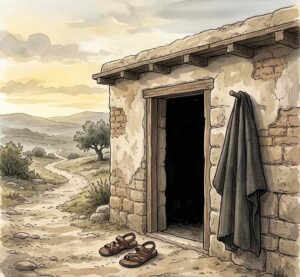
“Draw not nigh hither. Put off thy shoes from off thy feet, for the place whereon thou standest is holy ground.”
The command was immediate and physical. Remove your sandals. Feel the dirt beneath your feet. The ground you are standing on is not ordinary ground anymore. The presence of God makes the ordinary holy. A mountainside in Midian becomes a sanctuary. A thorn bush becomes a temple. The dusty earth becomes a place of worship because the Lord is there.
Moses hid his face. He was afraid to look upon God. The man who had once walked with the confidence of an Egyptian prince, who had struck down an oppressor with his own hands, who had intervened in the quarrels of his Hebrew brethren, now covered his eyes like a child. He had been bold when he was young. Now he was eighty years old, and forty years of silence in the wilderness had taught him humility.
Then the Lord spoke the words that revealed why the bush was burning.
“I have surely seen the affliction of my people which are in Egypt, and have heard their cry by reason of their taskmasters. For I know their sorrows. And I am come down to deliver them out of the hand of the Egyptians, and to bring them up out of that land unto a good land and a large, unto a land flowing with milk and honey.”
The words tumbled out like water from a spring. God had seen. God had heard. God knew. The affliction of the slaves had not gone unnoticed. Their cries had risen to heaven, and the Lord had received every one of them. The suffering of four hundred years was about to end. The promise made to Abraham in the darkness between the pieces of the sacrifice was about to be fulfilled.
“Come now therefore, and I will send thee unto Pharaoh, that thou mayest bring forth my people the children of Israel out of Egypt.”
The deliverer was being commissioned. The shepherd who had turned aside to see a burning bush was being sent back to the land he had fled. The man who had been rejected by his own people would now be their leader. The fugitive would become the liberator. And the flame that burned without consuming the bush was the sign that the God who called him would be with him every step of the way.
The Objections of the Shepherd
Moses answered the Lord with questions that revealed his fear. “Who am I, that I should go unto Pharaoh, and that I should bring forth the children of Israel out of Egypt?”
The prince who had once believed he could deliver his people by his own strength now asked who he was to attempt such a thing. Forty years of shepherding had stripped away his self-confidence. He knew his weakness now. He knew his limitations. And that was exactly where God wanted him. The Lord would use a man who knew he could do nothing in his own strength. The Lord would work through a vessel that had been emptied of pride.
“Certainly I will be with thee. And this shall be a token unto thee, that I have sent thee: When thou hast brought forth the people out of Egypt, ye shall serve God upon this mountain.”
The sign was the mountain itself. The bush was burning now, and the voice was speaking now, but the full confirmation would come later. When Moses returned to this same mountain with the entire nation of Israel behind him, he would know that God had sent him. The promise was a long view, a future hope, a guarantee that the impossible task would be accomplished.
Moses asked for the name of the One who was sending him. “Behold, when I come unto the children of Israel, and shall say unto them, The God of your fathers hath sent me unto you, and they shall say to me, What is his name? What shall I say unto them?”
And God answered with the name that would define the faith of Israel forever.
“I AM THAT I AM. Thus shalt thou say unto the children of Israel, I AM hath sent me unto you.”
The name was a declaration of eternal existence. The God who had called Abraham out of Ur, who had wrestled with Jacob at the Jabbok, who had preserved Joseph in the prison of Egypt, was the God who simply is. He has no beginning. He has no end. He depends on nothing and no one. He is the I AM, and his name is the ground of all reality.
The bush continued to burn. The flame continued to blaze among the branches without consuming them. And Moses stood on holy ground with his sandals in his hand, listening to the voice that would send him back to Egypt, back to Pharaoh, back to the people he had tried to save by his own strength and would now save by the strength of the I AM.