
The messengers had come back with nothing but fear. Jacob had sent them ahead to the land of Seir, to the country of Edom, with words of peace for his brother Esau. He had told them to say, “Thy servant Jacob saith thus, I have sojourned with Laban, and stayed there until now. And I have oxen, and asses, flocks, and menservants, and womenservants. And I have sent to tell my lord, that I may find grace in thy sight.”
The messengers returned with no message of peace. Only a warning. “We came to thy brother Esau, and also he cometh to meet thee, and four hundred men with him.”
The words struck Jacob like a blow. Four hundred men. His brother was not coming to embrace him. He was coming with an army. The hunter who had lost his birthright for a bowl of stew, the firstborn who had been cheated of his blessing by a brother in goat skins, was marching toward him with the force of a warlord. Twenty years of separation had not cooled his anger. The vow he had made in his heart, to kill Jacob after the days of mourning for their father, was about to be fulfilled.
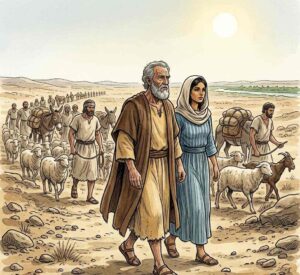
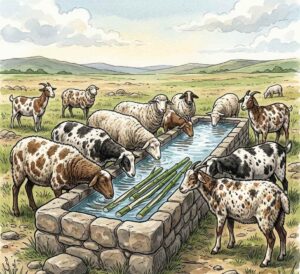
Jacob was greatly afraid and distressed. He divided his people into two bands, reasoning that if Esau attacked one, the other might escape. He prayed, reminding the Lord of the promise of protection and offspring. He sent waves of gifts ahead of him, hundreds of goats and sheep and camels and cattle, each drove driven by servants who were instructed to say the same words: “These be thy servant Jacob’s. It is a present sent unto my lord Esau. And behold, also he is behind us.”
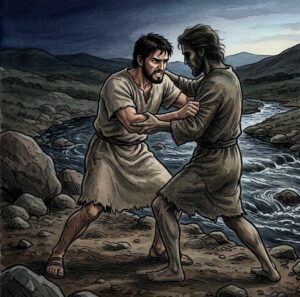
He sent his family across the Jabbok in the night. He wrestled with the man until daybreak. He received a new name and a lasting limp. And now the morning had come, and the time for running was over.
The Figure in the Distance
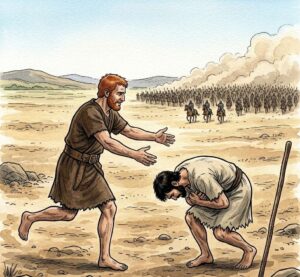
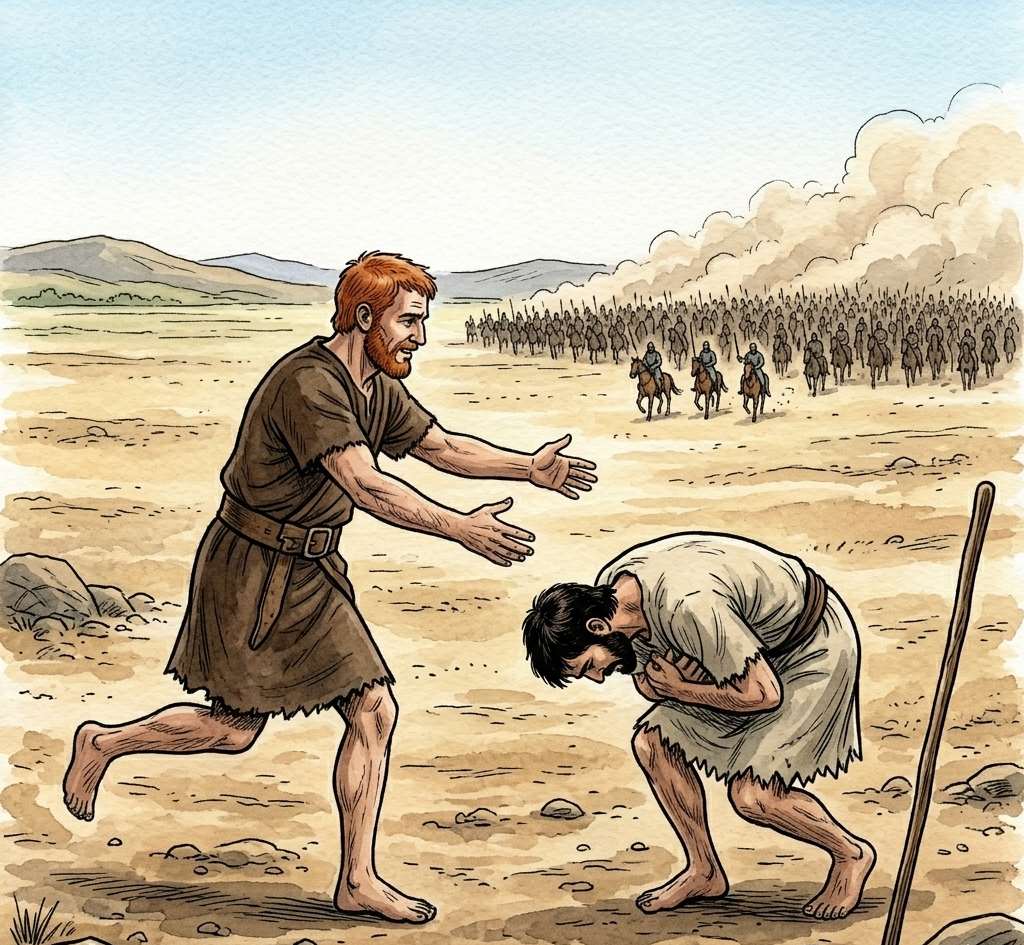
Jacob lifted up his eyes and looked. The sun was high now, and the plain stretched out before him, and in the distance he saw a cloud of dust. The cloud grew larger and darker, and soon he could see the figures moving within it. Men. Horses. The glint of weapons in the morning light. And at the head of them, one figure running.
Esau was running to meet him.
The last time Jacob had seen his brother, he had been fleeing for his life. The blessing was still fresh on his lips, the taste of the savoury meat still in his mouth, the goat skins still rough on his hands. Esau had wept and begged for a blessing of his own, and when Isaac had nothing left to give, the hunter had lifted up his voice and cried, “Hast thou but one blessing, my father? Bless me, even me also, O my father.” And then he had hated Jacob and planned to kill him, and Rebekah had sent her younger son away to Haran.
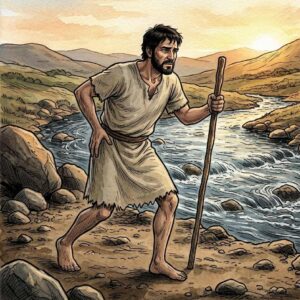
Now twenty years had passed. Jacob was returning as a wealthy man, with flocks and herds and servants and eleven sons. But all his wealth meant nothing in this moment. He could not buy his brother’s forgiveness with goats and camels. He could not outrun four hundred men on a leg that had been touched by God. He could only walk forward, limping, and face whatever was coming.
The Bowing
Jacob arranged his family. He put the handmaids and their children first, then Leah and her children, and finally Rachel and Joseph in the rear, the most protected position. Then he passed over before them and went to meet his brother. He did not send a servant ahead. He did not hide behind his wives and children. He went first, alone, his limp marking every step, his body bent toward the ground.
He bowed himself to the ground seven times as he approached his brother. Seven times his body bent. Seven times his hip screamed in pain. Seven times he lowered himself in the ancient gesture of complete submission. Each bow was a confession. I wronged you. I deceived our father. I stole what belonged to you. I am not coming as the supplanter anymore. I am coming as your servant.
The four hundred men stood behind Esau, watching. They had ridden out with their chief, ready for war, ready for vengeance, ready to avenge the old wrong that had been done to their lord. But Esau was running ahead of them, his feet pounding the dust, his arms outstretched.
The Embrace
Esau ran to meet him. He did not draw a sword. He did not shout in anger. He ran, and he embraced his brother, and he fell on his neck and kissed him. And they wept.
The two brothers who had struggled in the womb, who had been divided by favoritism and deception, who had spent twenty years separated by fear and anger, stood in the dust of Canaan and wept in each other’s arms. The tears of Esau were the tears of a brother who had let go of his hatred. The tears of Jacob were the tears of a man who had expected a sword and received a kiss.
Esau looked up and saw the women and the children. “Who are those with thee?” And Jacob answered, “The children which God hath graciously given thy servant.”
The handmaids came near with their children and bowed themselves. Leah came near with her children and bowed themselves. And last of all, Joseph came near and Rachel, and they bowed themselves. The whole household of Jacob bowed before Esau, the brother who had been wronged, the firstborn who had lost everything. And Esau asked about the gifts, the drove after drove of animals that had been sent ahead. “What meanest thou by all this drove which I met?”
“These are to find grace in the sight of my lord.”
“I have enough, my brother. Keep that thou hast unto thyself.”
“Nay, I pray thee, if now I have found grace in thy sight, then receive my present at my hand. For therefore I have seen thy face, as though I had seen the face of God, and thou wast pleased with me. Take, I pray thee, my blessing that is brought to thee. Because God hath dealt graciously with me, and because I have enough.”
The words were careful and profound. Jacob had seen the face of God at Peniel, and his life was preserved. Now he had seen the face of his brother, the face he had feared for twenty years, and that face was full of grace. The forgiveness of Esau was a reflection of the forgiveness of God. The brother who had every right to kill him had chosen to embrace him instead.
The Parting in Peace
Esau offered to travel with Jacob, to provide protection and companionship on the journey. But Jacob declined. His children were young. His flocks were nursing. He had to move slowly, at the pace of the weakest lamb and the smallest child. He could not keep up with the swift march of four hundred warriors. “Let my lord, I pray thee, pass over before his servant. And I will lead on softly, according as the cattle that goeth before me and the children be able to endure, until I come unto my lord unto Seir.”
Esau accepted. He offered to leave some of his men as a guard, but Jacob gently refused. The grace was enough. The forgiveness was enough. He needed no armed escort from the brother who had embraced him. So Esau returned that day on his way unto Seir, the four hundred men turning their horses and riding south toward the hills of Edom.
Jacob watched them go. The cloud of dust that had been a sign of terror in the morning was now a sign of peace in the afternoon. His brother had come with an army and left as a friend. The hunter who had been cheated of his blessing had found grace in his heart to forgive. And the man with the limp, the prince who had wrestled with God, had received back not only the land of his fathers but the brother he had wronged.
Jacob journeyed to Succoth and built a house there, making booths for his cattle. He crossed the Jordan and came to Shalem, a city of Shechem, in the land of Canaan. He pitched his tent before the city and bought a parcel of ground from the children of Hamor. And there he erected an altar, and called it EleloheIsrael, God the God of Israel. The promise of Bethel had been fulfilled. He had returned to the land. His brother had forgiven him. And the God who had wrestled with him in the darkness was still with him in the light.