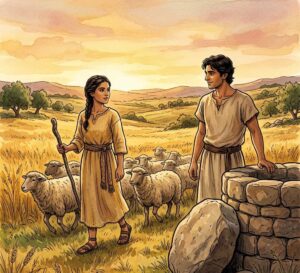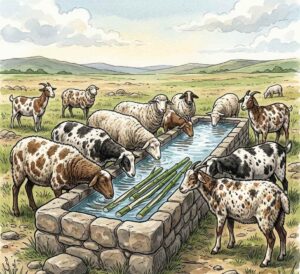

The land could bear only one of them. The flocks of Abram and the flocks of Lot had grown too large, and the herdsmen were fighting at the wells and the grazing grounds. The Canaanite and the Perizzite still lived in the land, watching these strangers argue over water and grass, and Abram knew that the strife between them made a poor witness in a country where they were already outsiders.
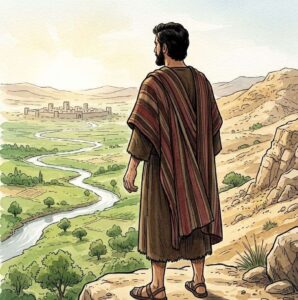
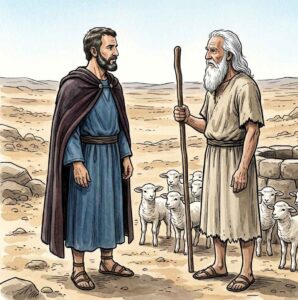
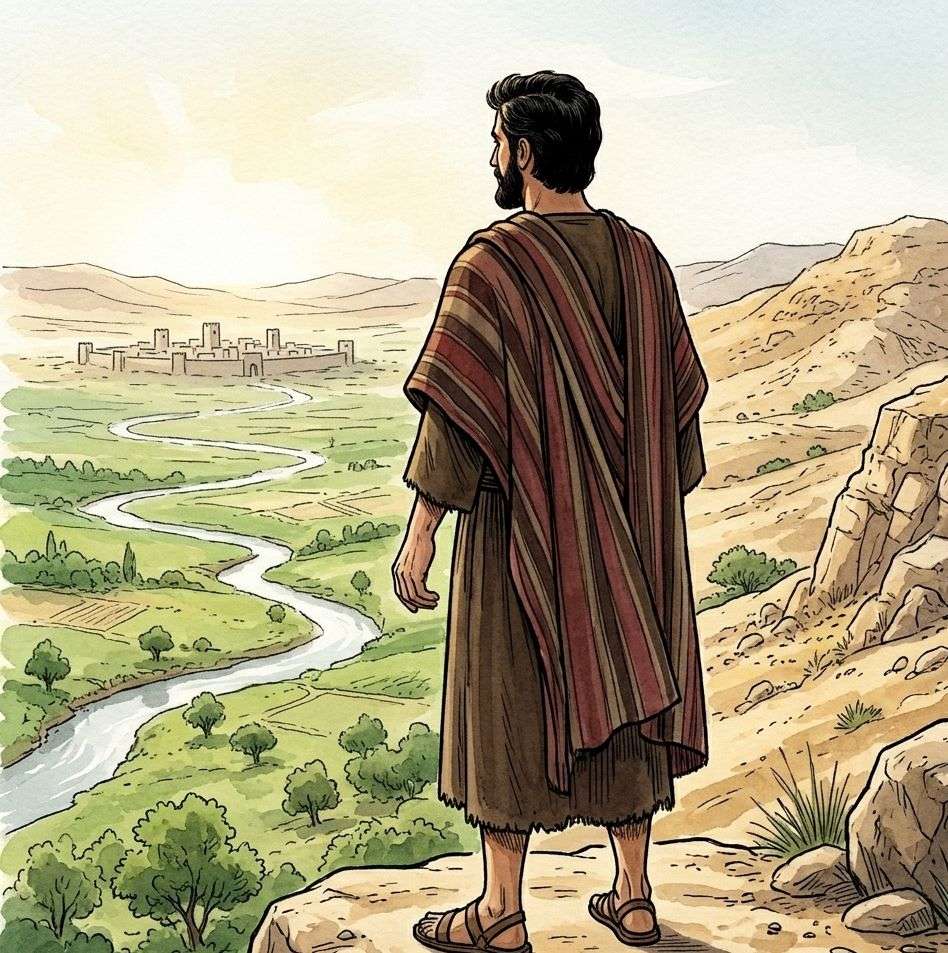
So Abram spoke to Lot. They stood together on a high place between Bethel and Hai, and the land spread out beneath them like a scroll unrolled. Abram looked at Lot, the son of his dead brother Haran, the boy he had taken with him when he left Ur and never looked back. Lot had grown rich beside him. His flocks had multiplied. His tents had spread across the hills. And now the ground could no longer hold them both.
“Let there be no strife, I pray thee, between me and thee, and between my herdmen and thy herdmen. For we be brethren. Is not the whole land before thee? Separate thyself, I pray thee, from me. If thou wilt take the left hand, then I will go to the right. Or if thou depart to the right hand, then I will go to the left.”
Abram gave Lot the first choice. He could have claimed it for himself. He was the elder. He was the one the Lord had called. The promise had been spoken to him, rather than to Lot. But he stood on the high place and offered the choice to his nephew, and Lot lifted up his eyes and looked.
The Lifting Up of the Eyes
Lot looked east. The land fell away toward the valley of the Jordan, and the river wound through it like a silver thread, and the plain was green. It was well watered everywhere, the Scripture says, like the garden of the Lord, like the land of Egypt as you go toward Zoar. The comparison was precise and terrible. The garden of the Lord was the place where man had first sinned. Egypt was the place where the people of God would one day groan under the lash of slavery. And the plain of the Jordan was beautiful and fertile and doomed.
Lot looked at the green valley and he chose it. He asked about the cities there only after his eyes had already decided. He asked about the people who lived in them only as an afterthought. He gave little weight to the welcome a stranger with large flocks might find among the men of the plain. He saw the water and the grass and the land that would feed his herds, and that was enough. His eyes made the choice before his mind could catch up. The green valley pulled at something in him, and he reached for it the way a man reaches for fruit that looks good to the eye.
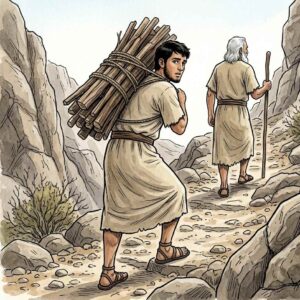
He chose all the plain of the Jordan. He took the whole circle of it, the watered land that stretched from the river to the foothills. And he journeyed east, separating himself from Abram who had raised him, and he pitched his tent toward Sodom.
Toward Sodom
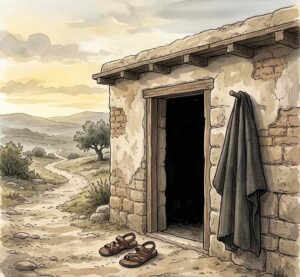
The words are careful. Lot pitched his tent outside Sodom. He stayed at a distance for a time. He pitched his tent toward Sodom. The city was still in the distance, its walls visible on the plain, its smoke rising against the sky. But his face was set in that direction. His door faced the city. His flocks grazed on the fields that bordered the city’s land. And every day the pull of the place grew a little stronger. The green valley had led him east, and now the city was drawing him in.
The Scripture adds a quiet note, almost as an aside, but it is the most important thing in the whole account. But the men of Sodom were wicked and sinners before the Lord exceedingly.
Lot knew this. The wickedness of Sodom was open and loud and notorious. The men of that city had made their name a byword for evil. And yet Lot had chosen the green valley anyway. He had looked at the watered plain and decided that the grass was worth the neighbors. He had weighed the riches against the risk and decided that his flocks mattered more than his family’s safety, more than his own soul.
He pitched his tent toward Sodom, and the direction of his door was the direction of his heart.
Abram Stays
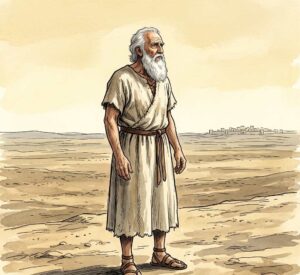
Abram stayed in the land of Canaan. He let the green valley remain with Lot. He kept his feet on the rocky ground, where the grazing was thinner and the wells were fewer and the promise of the Lord was the only thing that made the land worth living in.
And after Lot had gone, the Lord spoke to Abram again.
“Lift up now thine eyes, and look from the place where thou art northward, and southward, and eastward, and westward. For all the land which thou seest, to thee will I give it, and to thy seed for ever. And I will make thy seed as the dust of the earth, so that if a man can number the dust of the earth, then shall thy seed also be numbered. Arise, walk through the land in the length of it and in the breadth of it. For I will give it unto thee.”
Lot had lifted up his eyes and chosen with human sight, measuring the land by its grass and its water. Abram was told to lift up his eyes and see with the sight of promise, measuring the land by the word of the Lord. Lot took the green valley and got Sodom with it. Abram stayed on the rocky hills and got everything else. The whole land, north and south and east and west, would belong to his children. And Lot would lose even the green valley before the story was done.
The Tent Moves Closer
Lot abandoned the edge of the plain in time. The pull of the city was too strong. The grass of the valley had drawn him east, and now the gates of Sodom drew him in. The Scripture is silent about the day he moved from his tent into a house inside the city walls. It records none of the conversations he had with his wife, the arguments about whether to stay or go, the slow hardening of a decision that had been made long before when he first lifted up his eyes and saw the green valley.
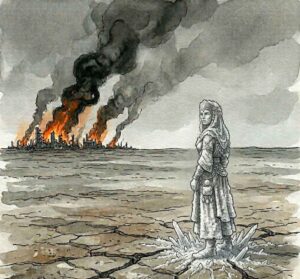
But the next time Lot appears in the story, he has left his tent behind. He is sitting in the gate of Sodom, the place where the elders of the city gathered to judge and trade and speak for the people. He has become a man of standing in a city of wickedness. He has risen in a place that is about to fall. He has traded his tents for a house and his flocks for a seat at the gate, and the green valley that looked so beautiful from the high place between Bethel and Hai is about to become a smoking ruin.
Abram stayed in his tent. He moved from Bethel to Hebron, to the plain of Mamre, and there he built another altar to the Lord. The altars kept multiplying. The promises kept coming. And Lot kept drifting toward the fire.
The Direction of the Door
The choice had been made with the eyes. Lot saw water and grass and the promise of wealth, and he reached for it without asking what it would cost. He sought no counsel from the Lord. He asked Abram nothing about the cities on the plain. He gave no thought to what it would mean to raise his children among the men of Sodom, to expose his daughters to the ways of a city that was ripening for judgment. He saw, he wanted, and he took, and the taking was his undoing.
Abram had also made a choice with his eyes. But his eyes had been lifted up at the command of the Lord, and the land he saw was still far from his possession, and the promise he believed would only come true long after his own breath had left him. He walked through the land as a stranger, a pilgrim, a man whose only title to the ground he walked on was the word of the God who had called him. And that was enough.
The sun set over the plain of the Jordan, and the lights of Sodom began to glow in the distance. Lot sat at the gate of the city, and his flocks grazed on the fields outside the walls, and his wife moved through the rooms of a house built with human hands on a foundation of human wickedness. The green valley was still green. The water still flowed. The city still stood. But the cry of its evil was already rising to heaven, and the day of its burning was already written in the book of the Lord.